
Recent studies show that 48 million people in the U.S. experience severe headaches from migraine disease. And 1 in 5 people with chronic migraine headaches say they’re “occupationally disabled,” meaning it limits their ability to work. But are migraines a disability that’s covered under the ADA? If so, many employers must make a reasonable accommodation for affected workers. But if your symptoms reduce your work productivity more than the reported 53% in the study we linked above, then you might qualify for Social Security disability.
Learn how to get migraine disability benefits from the Social Security Administration (SSA) below, including how to apply, qualify, pay amounts, and more.
Getting Disability Benefits for Migraine Headaches: Key Takeaways
- There’s no specific test to diagnose migraines, and triggers and symptoms vary from person to person. For this reason, getting an official medical diagnosis can be challenging.
- The frequency and severity of your episodes determine whether it counts as a disability to the SSA for benefit approval. If you miss work or come in late often due to your symptoms, then you’ll present a stronger case.
- You likely still need an attorney to get disability for migraines. Government reports show you’re 3x more likely to succeed on your first try and get your first payment within 180 days.
- Your symptoms alone will not qualify you for Social Security disability benefits. You also must show you meet technical eligibility requirements for federal programs or other types of disability benefits.
- How much money you receive in monthly disability depends solely on your past work income (SSDI) or current federal benefit level (SSI). Your pain level, number of diagnosed health problems, monthly bills, etc. don’t affect your benefit pay amount.
What Is Migraine Disease?
For someone living with migraine disease, it’s a lot more than just headache pain. In fact, this neurological condition can cause a range of physical symptoms. It often progresses through these four different stages:
- Prodrome, a warning phase of related symptoms which can start a day or two earlier.
- Aura, an initial phase where visual symptoms start and last for up to an hour (though not everyone living with migraine disease experiences this).
- Attack, the active phase with throbbing headache pain lasting anywhere from 4 hours to 3 days (if you do not treat it).
- Postdrome, the recovery period after an attack that can leave you feeling confused, worn out, or mentally drained.
Some people may experience migraines with no aura effects, while others experience migraine attacks without headache pain.
Common Migraine Symptoms That Can Affect Your Daily Life
According to the World Health Organization (WHO), migraines are the #3 cause of years of life lost to disabling conditions worldwide. Migraine symptoms that are most likely to disrupt your daily life and ability to perform required job duties include:
- Dizziness
- Fatigue
- Nausea
- Neck stiffness that makes turning your head from side to side painful or impossible
- Sensitivity to light, sound, touch, or some combination of those issues
- Vertigo
- Vomiting
Are Migraines a Disability According to the Americans With Disabilities Act (ADA)?
It depends entirely on how much each episode affects your ability to earn a living. While the Americans With Disabilities Act doesn’t list specific disabilities, it does provide reasonable accommodation guidelines. The Job Accommodation Network notes that migraines cost American workers 157 million productive work days every year. Here are some things your employer can do to help better manage your symptoms at work:
- Let you work from home as needed or have a flexible schedule
- Change the lighting in your workplace to be less triggering, or let you wear sunglasses
- Provide you with noise-canceling headphones or a private office to work in
- Install an anti-glare filter on your computer monitor
- Permission to skip potentially triggering work-related social events, like potlucks, holiday parties, teambuilding exercises, etc.
Two Social Security Administration Programs Offer Monthly Disability Payments to Eligible Applicants
Before the SSA looks at your medical history, first, they’ll want to make sure you meet all technical eligibility requirements. Those technical rules are quite different across each program. However, both evaluate your medical documentation for migraine disability benefits the same way.
Important: If you're still working when you apply for disability benefits from either federal program, the SSA will likely reject your claim.
Program #1: Supplemental Security Income (SSI)
While the SSA administers the SSI program, its payments come from the general tax fund, not the Social Security Trust Fund. That means SSI payments have zero impact on Social Security retirement benefits. Congress enacted Supplemental Security Income to replace state-run welfare programs starting in 1974.
To technically qualify for SSI, you must:
- Have total household income that falls below $2,019. That should include any money your spouse, roommate, or family members earn in addition to your own.
- Own less than $2,000 in assets you can easily sell for cash (or $3,000 for married couples). This asset limit does not include your home, vehicle, wedding ring, clothing, or furniture.
- Be blind, disabled, or at least 65 years old on the date you apply for SSI. The SSA’s definition of disability means proving you cannot work for a minimum of 12 months due to one or more eligible medical conditions.
Once the SSA confirms you meet all of the above, they’ll determine if your health condition counts as a disability. This typically involves a medical exam with the Disability Determination Services (DDS) office in your state.
Pro Tip: If you were born blind or are already 65+ years old, you likely won’t have to undergo a medical exam to prove you’re disabled.
If the SSA awards you SSI disability for migraines, you’ll also receive Medicaid coverage the same month as your first payment. Right now, the max SSI monthly payment is $994 per individual, or $1,491 per eligible couple.
Program #2: Social Security Disability Insurance (SSDI)
Social Security Disability Insurance is a federal program workers pay into through FICA payroll taxes. Not every worker pays Social Security taxes (Uber drivers, for example), but most do. About 76% of workers in the U.S. have SSDI coverage as of 2024, according to SSA data.
To qualify for SSDI, you must:
- Have monthly income that falls below $1,690 if you’re sighted or $2,830 if you’re blind. If you earn more than that, the SSA won’t approve your claim.
- Be younger than 67 and not getting any other Social Security benefits right now. This includes regular Social Security, early retirement, spousal, or SSI payments.
- Have enough and recent work history to still have active SSDI coverage. In simple terms, if you worked 5+ years in the last decade while paying Social Security taxes, you meet this requirement.
- Be unable to work at all for at least 12 months in a row, specifically because of one or more medical conditions. The SSA won’t even look at this last requirement until they check the first 3 bullet points listed above.
Pro Tip: It’s very difficult to prove you cannot work in any job at all for the foreseeable future. But if you’re aged 50-65, the rules to qualify for disability get a lot easier.
Two years (48 months) after SSDI approval you become eligible for Medicare coverage, regardless of your age. The maximum SSDI payment anyone can get is currently $4,152, while the average is $1,630 per person. Your monthly SSDI benefit will likely fall somewhere between these two amounts if you’re approved anytime soon. If you have eligible dependents (like your spouse or children), they can receive dependent SSDI benefits, too.

How to File Your Disability Claim for Benefits
The steps you’ll take to apply for disability benefits depends on which program you want to file under:
- Apply online at SSA.gov. This option is only available for SSDI benefits, not the SSI program.
- Apply in person at your closest Social Security office. Trump Administration policy requires you to make an appointment before you go. According to recent reporting, it could take 34 days or longer for your appointment date to arrive. Expect to spend 4-5 hours, minimum, filling out paperwork once you’re there.
- Have a local disability lawyer file your claim paperwork, free of charge. This is the only method that increases your chances for a successful claim on your first try.
Are Migraines a Disability That Appears in the SSA Blue Book?
Unfortunately, no. Migraines is not a listed impairment in the SSA Blue Book, which the agency uses to evaluate health issues. However, Social Security Ruling 19-4P provides guidance for DDS agents reviewing disability claims for primary headache disorders. This policy states the SSA follows ICHD-3 diagnostic criteria for evaluating migraines as a medically determinable impairment (MDI).
Why should this matter to you? Because it indicates the agency considers your migraine symptoms equal to a listed disability, if it meets certain criteria.
Essentially, the SSA wants to know whether your migraines seriously limit your functional ability to:
- Remember, understand, or apply information
- Perform physical tasks required for daily living, like laundry, cooking, cleaning, errands, and dressing and cleaning yourself
- Your ability to interact normally with others
- How well you adapt to or manage yourself in new situations
- Your ability to pay attention, stay focused on, or complete complex tasks and processes
What Medical Evidence Best Supports a Migraine Disability Claim?
Your doctor likely reached your migraine disease diagnosis after ruling out every other possible health issue. Here’s what you should include with your claim:
- MRI or CT scans ruling out other possible reasons for your symptoms, like a brain tumor
- Blood test results that rule out other possible triggering sources (i.e., thyroid disorders, dehydration, malnutrition, or autoimmune conditions)
- A signed Residual Functional Capacity (RFC) form from your doctor that shows your symptoms persist, despite regular medical treatments
- What medications you to take to control your pain or other symptoms, including dosage, frequency, and side effects
Finally, the most important medical documentation you can provide is a daily symptom diary. If you don’t have one of these yet, you need to start. Track all of the following information:
- How often you experience migraines, including how long each individual episode lasts
- What led up to the attack (your diet, what you were doing before symptoms began, etc.)
- If you experienced any other migraine symptoms, like nausea, vomiting, confusion, light sensitivity, dizziness, etc.)
- How severe you’d rate each symptom you experienced and how much it affected your ability to function normally
While that last bullet might sound tricky, it’s pretty easy to do. A couple of scientists devised a great system that shows your disability level for each migraine attack. It’s called the traffic light system, and here’s how it works:
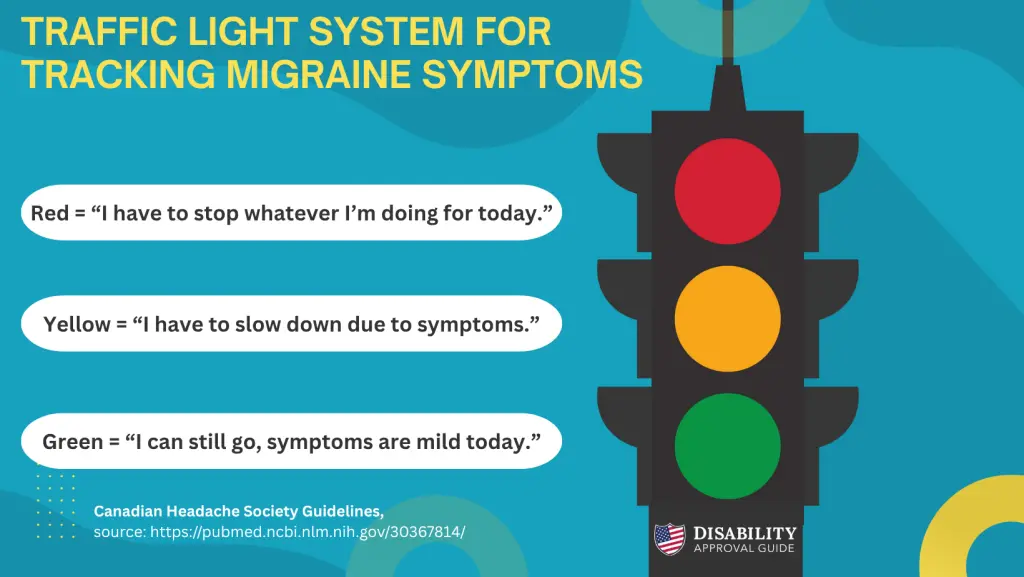
Simply label each headache diary entry as red, yellow, or green. You can buy colored markers and draw a colored square around each separate entry, if you like. This info may be more helpful to DDS agents trying to determine if you’re disabled than using a traditional pain scale of 0-10.
Related Conditions That May Help You Get Disability Benefit Approval
Social Security Ruling 19-4P mentions epilepsy as having closely related criteria used to evaluate migraine disability claims. Other conditions migraine patients commonly have that can strengthen your claim include:
- Anxiety
- Chronic sinusitis
- Depression
- Fibromyalgia
- Insomnia
- Irritable bowel syndrome (IBS)
- Heart conditions
- Long COVID
- Post-Traumatic Stress Disorder (PTSD)
- Sleep apnea
Pro Tip: If you have a qualifying disability listed above, put that down as your primary condition. Then list migraines as a secondary condition, which make make benefit approval easier for you. Most people approved for Social security disability benefits listed multiple health issues on their applications (62%).
Get Free Help Qualifying for Migraine Disability Payments
If you suffer from migraine symptoms that negatively impact your daily life and job performance, we want to help you. Let us connect you with a local attorney who can review your situation and then tell you, free of charge:
- Whether you may qualify for benefits, and from which program
- Estimate of how much your monthly payments could be
- How to fix your paperwork and appeal if the SSA already denied you benefits once
- Info on local, regional, or state assistance programs that can help you in other ways right now
You don’t have to go through this alone. A free consultation is the best way to get your questions answered and understand all of your options. If you decide to work with an attorney on your claim and don’t get benefits, you’ll pay $0 in legal fees. And if you’re successful, then you’ll only owe one small fee afterwards.
Ready to join the more than 10,000 disabled people we’ve already helped? Click below to see if you may qualify for a free claim consultation now:
Get Your Free Benefits Evaluation
Lori Polemenakos is Director of Consumer Content and SEO strategist for LeadingResponse, a legal marketing company. An award-winning journalist, writer and editor based in Dallas, Texas, she's produced articles for major brands such as Match.com, Yahoo!, MSN, AOL, Xfinity, Mail.com, and edited several published books. Since 2016, she's published hundreds of articles about Social Security disability, workers' compensation, veterans' benefits, personal injury, mass tort, auto accident claims, bankruptcy, employment law and other related legal issues.